The Search Evolution Ladder · Part 2 · Infographic
Meet the seller halfway on words
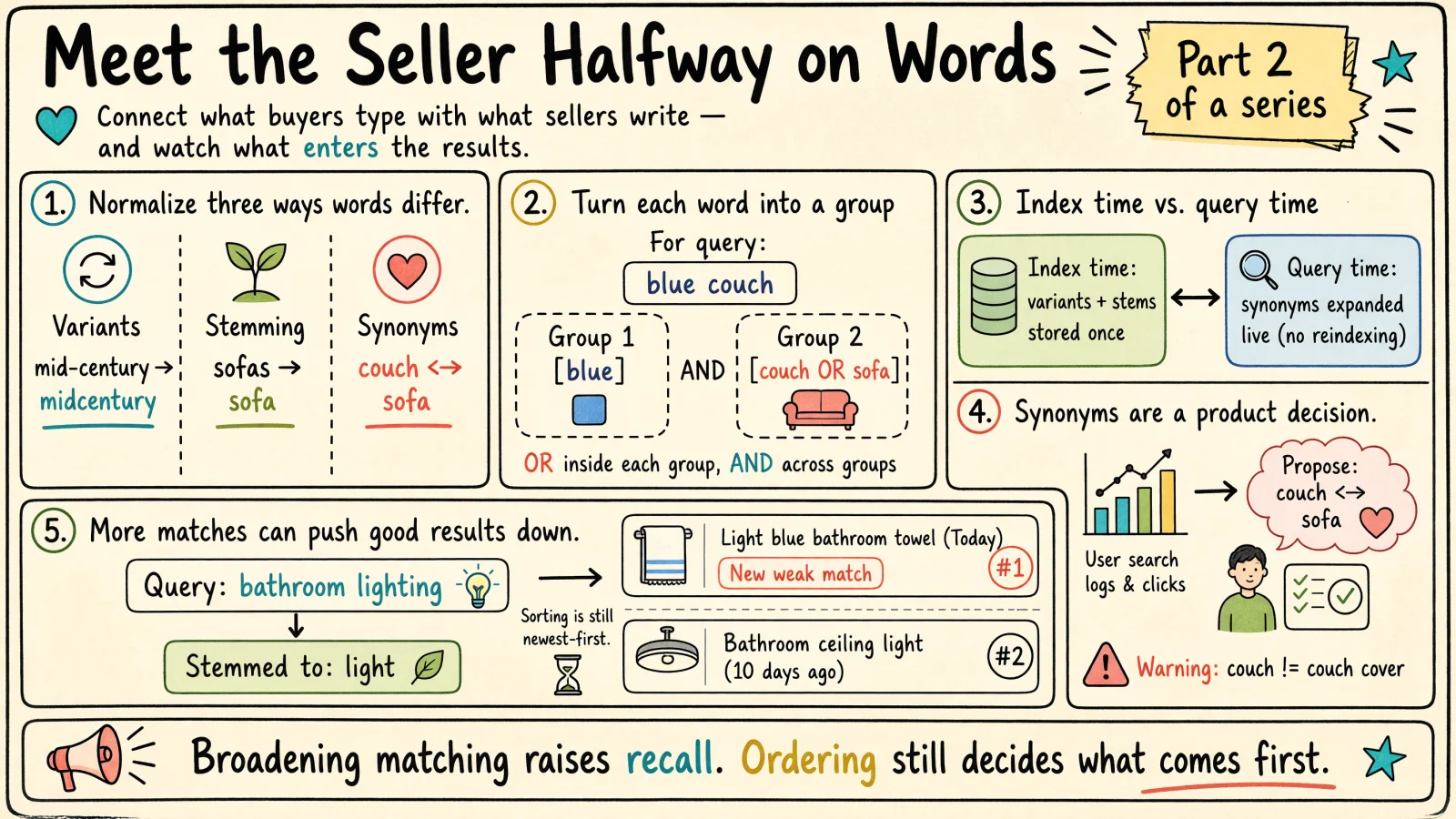
Text version
- Normalize three ways words differ. Collapse spelling and spacing variants ("mid-century" → "midcentury"), reduce word endings with stemming ("sofas" → "sofa"), and connect equivalent words with synonyms ("couch" ↔ "sofa").
- Turn each word into a group. For "blue couch", Group 1 is [blue] and Group 2 is [couch OR sofa]. Combine alternatives inside a group with OR (union), and require every group with AND (intersection). Expanding "couch" does not make "blue" optional.
- Index time vs. query time. Normalize variants and store stems at index time so both sides speak the same language. Expand synonyms at query time so you can add or fix rules immediately without reindexing the catalog.
- Synonyms are a product decision. User query rephrasings and shared clicks can propose candidate pairs, but a human still needs to verify them. Words that match in one query ("couch" ↔ "sofa") can fail in another ("couch cover").
- More matches can push good results down. Stemming "bathroom lighting" to "light" admits weak matches like a "Light blue bathroom towel". Because sorting is still newest first, a weak new match can outrank an older exact match.
Broadening matching raises recall. Ordering still decides what comes first.